

THE RADIOS
During the 1940s, classic radios were a household essential, serving as the primary source for news, music, and everyday information people relied on.Lorem ipsum dolor sit amet, consectetur adipiscing elit. Ut elit tellus, luctus nec ullamcorper mattis, pulvinar dapibus leo.
- STEP 1: When these radios first arrive, they are often in rough shape—sometimes even worse than expected. Many are dirty, scratched, and show clear signs of age, having served as shelter for mice or insects. You can easily imagine the condition they’ve been through.
- STEP 2: The next stage involves a complete teardown. Any old or unusable components are removed, followed by a thorough cleaning. The cabinets are sanded down, cleaned once more, stained, and finished with a clear protective coat. New fabric is installed, along with a freshly made faceplate to restore their original charm.
- STEP 3: The final step is fitting the radios with modern equipment. A new amplifier and bass speaker are installed inside the cabinet, along with a connection for an iPod. Each unit also includes a turntable and an antique-style table to place it on. Speakers are provided as well, with the option to add more if desired.


1940
General Electric Model J805
- Sony STR-DH550 Receiver
- Kenwood 12"
- Pioneer PL-990 Turntable
- Polk TSi 200 Speakers
- CD Player
- iPod Hookup
- Antique Table
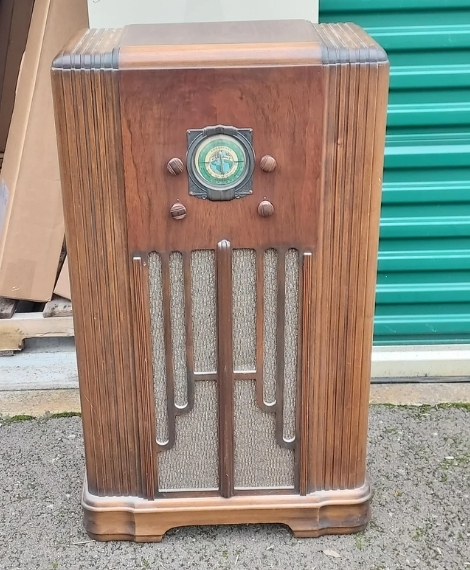
1941
Silvertone
- Polk TSi 200 Speakers
- Sony STR-DH550 Receiver
- Pioneer PL-990 Turntable
- Kenwood 12"
- iPod Hookup
- CD Player
- Antique Table
TRANSFORM YOUR RADIOS
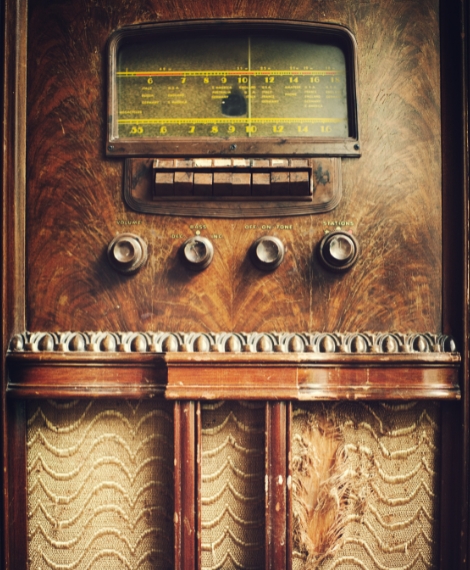
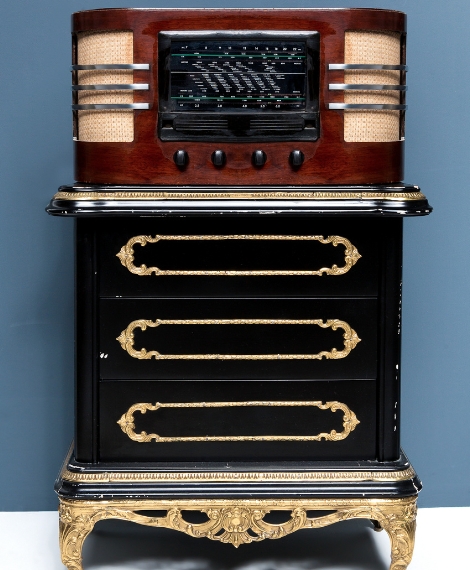
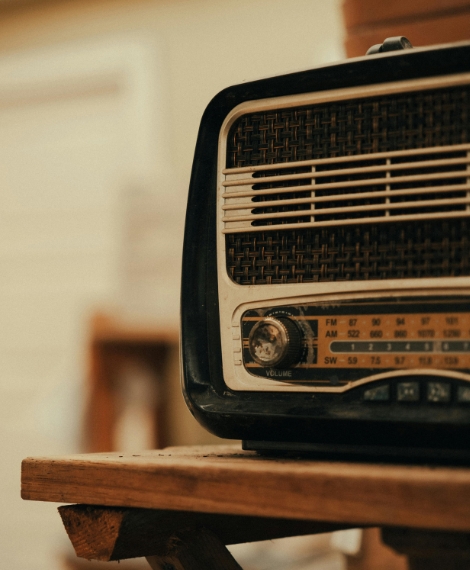
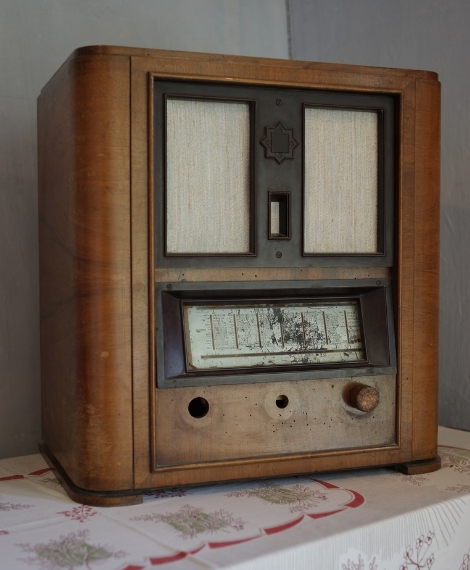
This was one of the very first radios to arrive at the workshop. It was discovered in a high school and had clearly been mistreated—so much so that many would have considered it beyond repair and destined for the scrapyard.
- The restoration begins with a full teardown of the cabinet. These radios are typically extremely dirty both inside and out. Most of the original screws are replaced, and any cracks or damaged wooden panels are carefully repaired.
- The cabinet is then stripped down further and thoroughly sanded. Any cracks, holes, or wear that the wood has accumulated over decades are filled and corrected to restore structural integrity.
- The inside of the cabinet is also sanded and cleaned. Damaged boards are replaced, and the entire interior is sealed to ensure durability and long-term protection.
- Once preparation is complete, the cabinet is fully stained using a rich, dark finish and sealed with a clear coat to protect the wood and enhance its appearance.
- The original 1940s cloth is removed and replaced with new material, positioned to accommodate the installation of a new bass speaker behind it.
- The receiver, CD player, and new bass speaker are then installed neatly inside the cabinet, integrating modern functionality with the classic design.
This stage showcases the front view of the radio with all electronics installed. This particular model includes a pre-amp and mixer alongside the CD player. All radios feature a custom laser-cut front plate designed to fit precisely around the receiver—and, on most models, the CD player as well. These laser-cut plates are smooth, accurately fitted, and free of the rough edges commonly found in saw-cut panels.